
The real benefits of Aqua Cycling – expert opinions
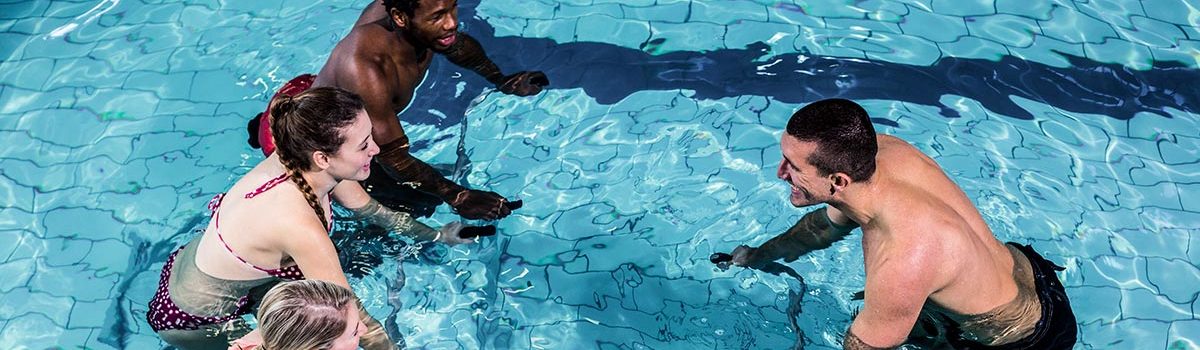
Over the last 10+ years aqua cycling has become an increasingly popular fitness activity in Europe and the USA. As such it has drawn the attention of Exercise and Sports scientists, Health and Medical scientists and many others. The benefits of aquatic exercise and the benefits of spinning or cycling for people with ankle, knee, hip or back injuries or pain have been discussed since the 70’s but adding these two things together is still relatively new. However, there has been several key discussions about the benefits and advantages of Aqua Cycling over traditional aquatic exercise, and traditional spinning/cycling.
The key benefits of Aqua Cycling are its low impact, low risk environment coupled with key muscle toning. In general land-based exercise therapy has been shown to have a positive impact in improving physical functioning in people with knee osteoarthritis, and other rehabilitative knee or hip related issues. Spinning exercises, as an example, is a popular and beneficial land-based exercise to improve mobility and functionality of people with knee and hip related issues, due to the reduced physical impact of the exercise. The challenges with land-based exercise is that even the smallest physical impact can cause pain and therefore there are limitations on the range of exercises, even spinning is limited to in-saddle positions to prevent excessive weight bearing. Aquatic exercises, due to the buoyancy of the water, reduce weight bearing problems and provide significantly more possibilities. Aqua Cycling, as an alternative to spinning, allows out of saddle or less seated positions, and therefore additional exercise alternatives which greatly improve physical functioning.
The combination of water immersion and cycling movements help to reduce joint pain significantly. Simple immersion in water increases blood flow and oxygen delivery to the skin and muscles, which helps your body naturally deal with pain affected areas. The water also adds slight pressure, reducing the chance of joint swelling, similar to compression clothing, these both add to muscle relaxation and pain relief. Adding Aqua Cycling activates the calf-muscle pump, the soleus muscles, more effectively than other aquatic exercises which improve blood flow and help to reduce pain and inflammation further. Lastly the buoyancy of the water not only reduces the direct pain, as discussed previously, but also lends to maintaining stability while pedalling. This allows for greater support of the back and hip areas and reduces the chances of jerky movements, leading to further damage of the joints.
Aqua Cycling is truly a comprehensive approach to rehabilitation and an excellent way to ensure full functionality without all the pain. So, when we say it is low impact, low risk and for fitness, rehabilitation and fun, we truly mean it.
See References:
Williams, Haley. “Aqua cycling a cool trend for fitness and rehabilitation.” Health Times. Published: 19-03-2019. Accessed: https://healthtimes.com.au/hub/exercise-physiology/13/news/hw/aqua-cycling-a-cool-trend-for-fitness-and-rehabilitation/3965/?fbclid=IwAR29MWNB7SAMTfUlNpHGLw_Y1CwIcZzr-7h7omJ7UkOY_FSuhNRlj9IVFVo#:~:text=According%20to%20Ms%20Swan%2C%20aqua,circulation%20and%20facilitates%20fat%20elimination
Rewald, S., Mesters, I., Lenssen, A.F. et al. Effect of aqua-cycling on pain and physical functioning compared with usual care in patients with knee osteoarthritis: study protocol of a randomised controlled trial. BMC Musculoskelet Disord 17, 88 (2016).
Rewald, S., Lenssen A.F., Emans, Pieter. et al. Aquatic Cycling Improves Knee Pain and Physical Functioning in Patients With Knee Osteoarthritis: A Randomized Controlled Trial. Archives of Physical Medicine and Rehabilitation 101, 8 (2020) pp 1288-1295.
Rewald, Stephanie (2017). Knee Osteoarthritis and Aquatic Cycling, Development and evaluation of an exercise programme. Care and Public Health Research Institute (CAPHRI), Department of Epidemiology, Maastricht University, Netherlands.